
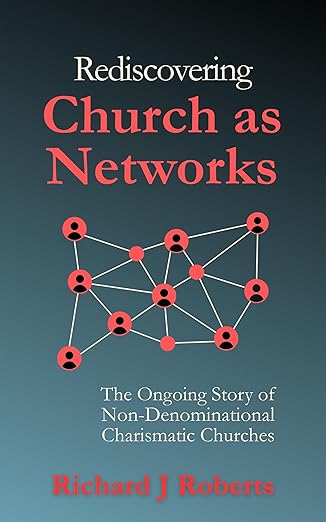
Rediscovering Church as Networks
The Ongoing Story of Non-Denominational
Charismatic Churches
Dr Richard J Roberts (Finnian Press 2026)
The Non-Denominational Charismatic Churches – also known as New Charismatic Churches (NCCs) – represent a global phenomenon comprising millions of believers who seek to prioritize “life first and system second”. Their primary structure is built on voluntary relational ties rather than formal institutional hierarchies. These churches consider themselves a distinct stream within the global Church, separate from both traditional Pentecostalism and the Charismatic Renewal movements within historic denominations.
Historical Foundations
The Charismatic Movement’s history is often categorised into three “waves” of the Holy Spirit. The First Wave was the birth of modern Pentecostalism in the early 1900s. The Second Wave involved the Charismatic Renewal within mainline denominations during the 1960s and 70s. The Third Wave, emerging in the late 20th century and associated with figures like John Wimber, brought charismatic practices into Evangelical circles without necessarily requiring a “baptism in the Spirit” as a distinct second event.
While many in the Second Wave sought to renew their existing denominations, some in the NCC movement pursued Restorationism—the belief that God is restoring the Church to the original patterns, DNA, and “fivefold ministries” (apostles, prophets, evangelists, pastors, and teachers) described in the New Testament. In the UK, this took the form of the “House Church Movement,” sparked by theological reflection at small conferences held in Devon in the 1950s. In North America, the movement was more mission-driven, often emerging from the 1960s “Jesus Movement” and groups like the Vineyard.
Theology and Core Practices
Theologically, NCCs are rooted in the Evangelical tradition, upholding a high view of Scripture and the necessity of personal conversion. However, they are defined by their continuationist view—the conviction that spiritual gifts such as prophecy, healing, and speaking in tongues are still active today.
Key practices include:
• Relational Ecclesiology: NCCs view the “ekklesia” (church) primarily as a gathered community of disciples rather than an institution.
• Koinonia and Small Groups: The fundamental building blocks are often midweek home groups where “sharing life together” occurs.
• Team Leadership: Leadership is typically collegial rather than solo, with “locally grown” leaders often trained through apprenticeships rather than formal seminaries.
• Expressive Worship: Gatherings are characterized by contemporary music and the active expectation of encountering God through the Spirit.
• Believers’ Baptism and Communion: They practice baptism by immersion for believers and view the “Breaking of Bread” as a means of receiving grace.
Apostolic Networks
A defining feature of NCCs is the use of apostolic networks instead of denominations. These networks are seen as the “unseen architecture of the Spirit,” where leaders and churches connect through shared vision and “spiritual parenting”. We can distinguish between vertical networks, which have tighter, top-down authority, and horizontal networks, which are looser and focus on providing resources and support.
In the UK, networks like Newfrontiers and Pioneer have become significant parts of the religious landscape, with some even partnering with the Methodist Church for new initiatives. The model has flourished in the Global South, notably in China’s underground house churches, which function as vast relational networks under the guidance of senior “uncles” and “aunts” who function as apostolic leaders.
Concerns and Challenges
The movement faces significant internal and external criticism, much of it centred on the New Apostolic Reformation (NAR). Key areas of concern include:
• Governance and Authority: Critics warn that viewing apostles and prophets as governmental offices can lead to authoritarianism and celebrity-driven leadership.
• Dominionism and Politics: Teachings like the Seven Mountain Mandate—the idea that Christians should “take over” societal spheres—have been criticized for moving from serving society to seeking to control it.
• Strategic Level Spiritual Warfare (SLSW): The practice of confronting “territorial spirits” is often criticized for having a thin biblical foundation.
• Accountability: High-profile scandals and moral failures have highlighted a lack of robust disciplinary processes in some network structures.
There is also a pressing need for greater biblical literacy to guard against new teachings that may be based more on personal experience than sound exegesis.
The Future of the Movement
As the NCCs move into their second and third generations, several trajectories are visible. While some scholars predicted networks would inevitably become denominations (the “routinization of charisma”), many networks have shown innate flexibility, evolving into “meta-networks”, or multiplying into smaller hubs to maintain a relational feel. There is also a notable resurgence of home-based churches (micro-churches) among believers seeking intimate community away from larger church structures.
Ultimately, the goal for these churches is to remain a “sign, instrument, and foretaste” of the Kingdom of God, balancing cultural relevance with a commitment to the apostles’ teaching. Their future likely depends on their ability to maintain humility and accountability while fostering the apostolic vitality that characterized their origins.
© Richard J Roberts 2026
Not to be reproduced without permission
Rediscovering Church as Networks is available from Amazon, Barnes and Noble etc.
Leave a Reply