
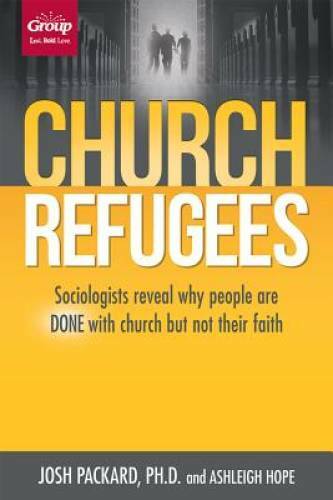
Church Refugees: Sociologists reveal why people are DONE with church but not their faith Paperback – June 1, 2015
by Josh Packard Ph.D (Author), Ashleigh Hope (Author), Group Publishing (Author)
Available on Amazon
Review by Bill Wagner, Author of The House Church Life, a reflection of how Parkland House lived out their faith in homes and close-knit Christian communities.
When Thom Schultz interviewed me in 2015 for research he was doing on why churches were closing their doors and why house churches like mine was gaining success and growing, he gifted me a copy of Church Refugees and introduced me, online, to Josh Packard who is a Christian Sociologist and the author of “Church Refugees.”
Josh and a Vanderbuilt student working for her doctorate at the time, Ashleigh Hope, conducted a landmark research project prompted by certain assumptions and they hoped to garner evidence to support those assumptions. They assumed that the reason for so many people leaving their churches to never return again were because of the popular and more publicized actions of the dark side of traditional Christianity: The poor behavior of pastors and leaders (sexual abuse and other abuses, embezzling funds, pastors cheating on their wives, etc) and how these things were being exposed at an alarming rate.
They were wrong.
They interviewed in depth nearly 100 people over a period of 18 months who left the church. Diversity geographically and socioeconomically (average income in 2014 being $55,745 and average age being 40—ages 18 through 84 years were interviewed). 56% of those interviewed were female.
Packard learned that it is no small thing for a person who has a huge history of being a part of a church to finally leave. Usually a season of bitterness or guilt associates the departure. Often anger continued to power the separation. Packard states that no one enthusiastically walks away from a church or eagerly embraces the feelings of shame and guilt. Leaving church is no small decision.
So in 140 some pages he unpacks what it is that are common among those who left the church, but notably did not leave their relationship with Christ. This is a good book. I even saw myself in his research as I read it.
He says that refugees are people who were forced from their homes when they would have preferred to stay. Church Refugees reflect the lives of those who would not have ever left the church if it were not for the feeling of being forced to leave. Not by choice, but reasons that are tangible and real.
Hopefully most of these people would find some way to gather, a house church was what I moved toward. I didn’t start a house church because I was forced out of church, but because I wanted to capture those who had been hurt and offer the rescue of a fellowship that understands them and to give them a voice. This book helped me to understand them better.
This is 10 year old research in a 10 year old book, but you will find that if anything has changed in 10 or so years, it is that the exodus is growing. Barna, PEW, LifeWay all give different numbers of how many churches are folding and going out of business each WEEK, but one thing is clear, the trend is consistent and the trajectory is constant between the researchers.
Church Refugees is still a good book to have and refer to on your shelf. Understanding how people think and feel is important. There are so many emotions connected to those reasons for leaving a church, the pain seems to be about the same as being involved in a bad divorce.
If not anything else, this book will help us to understand others who come into our houses who have strong, emotional opinions that power their frequent criticisms. Be gentle with these people. They were hurt and their experiences are real. Love them as your own family… because that’s what they are. They are now your family.
Leave a Reply